Sonal Gupta
Publication Writer II
Senior Medical and Scientific Writer
Publications | Medical Communications | Medical Affairs | Evidence Synthesis
About Me
PhD-qualified Medical & Scientific Writer with more than six years of experience developing scientific publications, medical communication materials, clinical documents, and healthcare content for pharmaceutical, biotechnology, and healthcare organizations.
I have independently managed the complete publication lifecycle—from literature search and evidence synthesis to manuscript development, journal submission support, reviewer responses, and reference management. My experience spans original research articles, systematic literature reviews, narrative reviews, conference abstracts, posters, scientific presentations, clinical reports, and healthcare education materials across multiple therapeutic areas.
Work Experience
Aug 2024-Present
Publication Writer II
Maverick Medicorum Pvt. Ltd.
Crafting articles and reports entailing research outcomes in health & medical,
focusing on therapeutic areas: oncology, cardiovascular diseases, and gynecology.
• Designing and developing scientific posters, abstracts, and manuscripts that
effectively communicate complex data and findings to diverse audiences.
• Analyzing patient-reported outcomes data and clinical trial results to create
engaging and informative content that meets publication standards.
• Collaborating with cross-functional teams to ensure alignment on project
objectives and timelines, facilitating the smooth execution of writing assignments.
• Conducting thorough literature reviews to support the development of high-quality
scientific content, ensuring accuracy and relevance.
• Managing multiple writing projects, prioritizing tasks to meet strict deadlines.
• Ensuring compliance with international regulatory requirements and ethical
standards in all written communications.
• Participating in peer reviews to enhance the credibility of published materials.
Education
2015-2020
Doctorate
Amity University
Selected Work
Original Research Manuscript
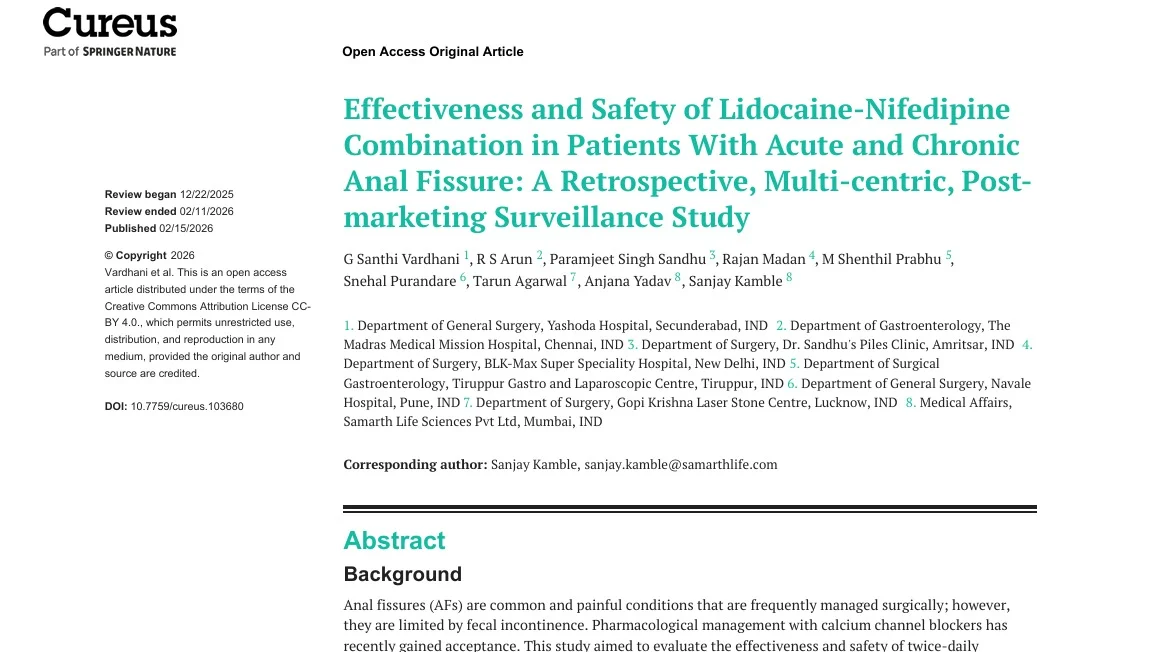
This retrospective, multicentric post-marketing surveillance study evaluated the effectiveness and safety of topical nifedipine (0.3% w/w) and lidocaine (1.5% w/w) cream in 431 patients with acute anal fissures (AAF) (n=290) and chronic AF (CAF) (n=141) across 46 centers. Patients were followed for eight weeks. The primary outcome was fissure healing, while secondary outcomes included pain relief using the Visual Analogue Scale (VAS), reduction in bleeding per anus, and safety assessment. By Week 8, the proportion of healed fissures increased significantly, while reductions in pain scores and bleeding per anus compared with baseline were observed (p<0.0001). Healing rates were comparable between AAF and CAF. However, patients with AAF experienced greater improvement in bleeding during Weeks 7–8 and lower VAS scores at Week 8 (p<0.05), with only mild adverse events reported.
Randomized Controlled Trial
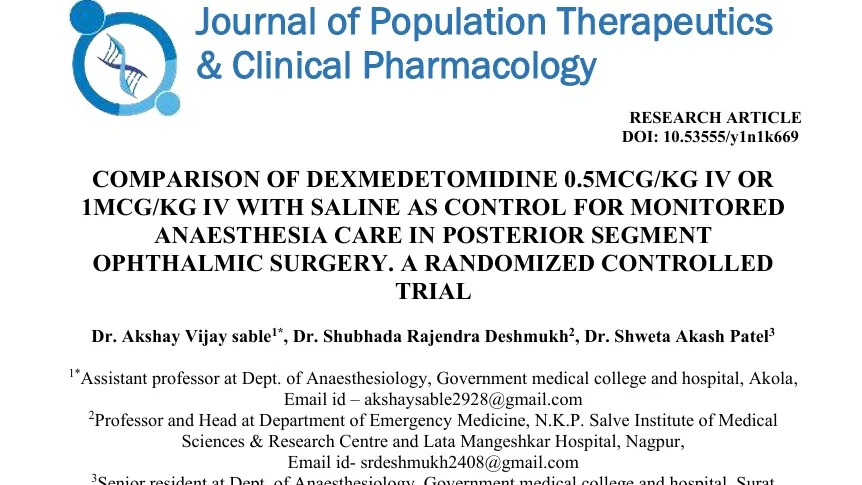
This double-blind, block-randomized controlled trial evaluated the efficacy and safety of dexmedetomidine (0.5 µg/kg and 1 µg/kg) for conscious sedation during posterior segment ophthalmic surgeries under local anesthesia. Seventy-five patients were randomized into three groups to receive dexmedetomidine 0.5 µg/kg, dexmedetomidine 1 µg/kg, or saline placebo. Sedation, analgesic requirements, hemodynamic variables, respiratory parameters, recovery, and adverse events were assessed. Both dexmedetomidine groups achieved significantly better intraoperative sedation during the first 60 minutes and required lower doses of rescue midazolam and fentanyl than the placebo group (p<0.0001), along with comparable adverse events across groups. Although both doses demonstrated similar efficacy, the 0.5 µg/kg dose offers a favorable safety profile with few adverse effects, supporting its utility as the preferred dose for monitored anesthesia care in posterior segment ophthalmic surgeries.